Here is a question worth sitting with for a moment.
You are spending money on marketing. Maybe it is Google Ads, Meta campaigns, email newsletters, SEO, social media content, or a combination of all of them running simultaneously. Your team is active. Campaigns are live. Everyone is sending reports. Numbers are being discussed in meetings.
But when was the last time you could say, with complete confidence, exactly which of those efforts brought in your last ten clients?
For most businesses, that question does not have a clean answer. And that silence, that uncertainty, is costing far more than most people realize.
When Activity Starts Looking Like Progress
One of the most common and expensive patterns in modern marketing is this: activity gets mistaken for results.
The content calendar is full. The ads are running. The team is doing everything they are supposed to do. Reports arrive with graphs showing healthy-looking numbers. Impressions, reach, sessions, clicks. And because the graphs look reasonable, the budgets keep flowing and the decisions keep getting made.
But here is the uncomfortable truth. Impressions do not pay your bills. Clicks do not close your deals. A website that receives fifty thousand visitors a month and converts none of them into enquiries is not a success story. It is a warning sign that something in the strategy, the targeting, or the website experience is broken.
The businesses growing with real confidence right now are not the ones with the most marketing activity. They are the ones who know, with clarity, which channels are bringing in clients and which are quietly consuming budget without returning value. That kind of clarity does not come from instinct or positivity. It comes from data, and specifically, from using Google Analytics 4 (GA4) properly.
What Exactly Is GA4?
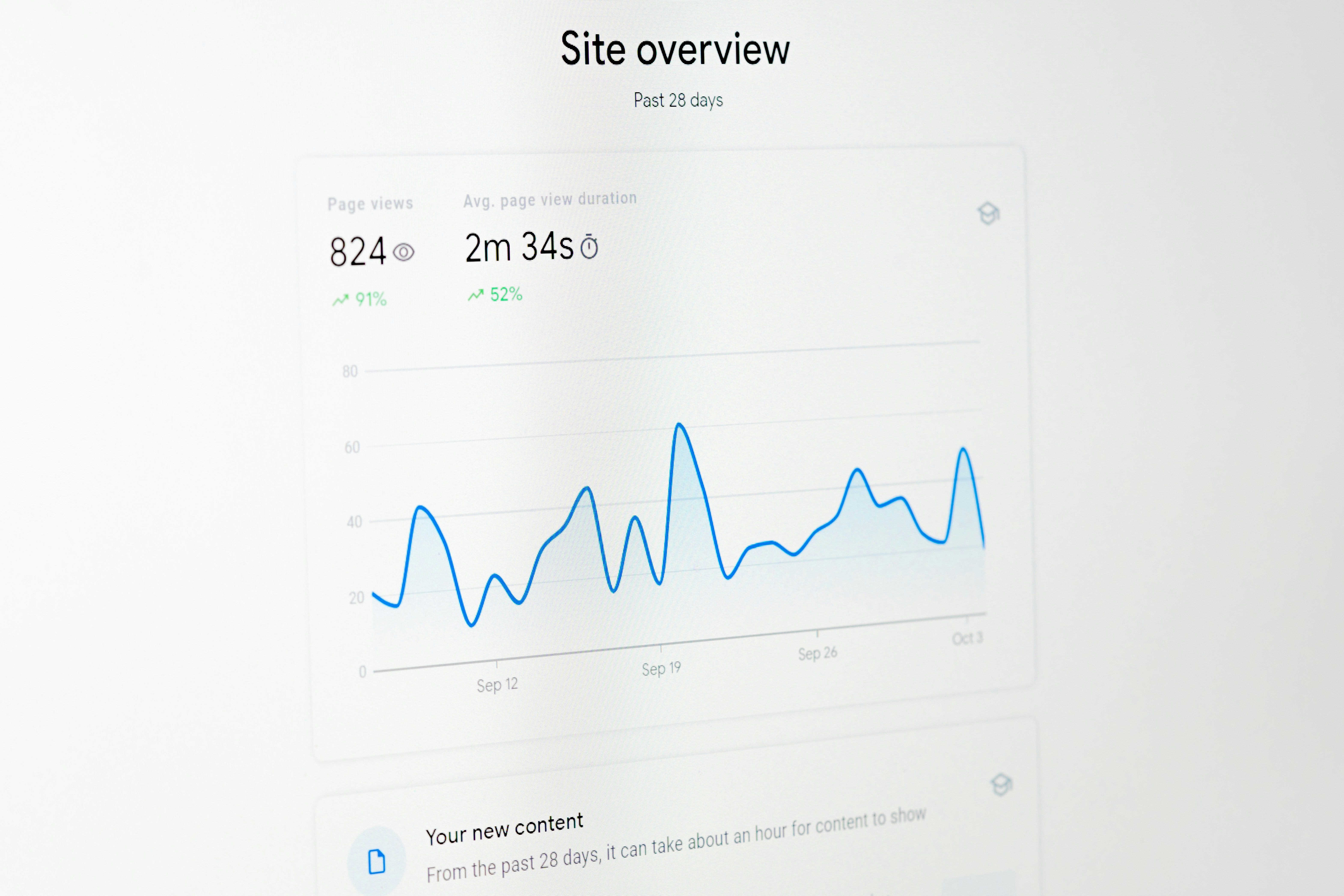
Image source: Unsplash
Google Analytics 4 — GA4 for short — is Google's current analytics platform. It replaced the older Universal Analytics in 2023 and brought with it a fundamentally different way of understanding how people behave on your website.
The old platform was built around page views. It told you that someone visited a page. GA4 goes much further than that. It is built around events; meaning it tracks what visitors actually do when they arrive. Did they scroll to the bottom of your services page? Did they click your contact button? Did they watch a video, fill in a form, or spend eight minutes reading your pricing page before leaving without taking action?
Every one of those interactions becomes a measurable data point. And when those data points are read correctly, they stop being abstract numbers on a screen and start becoming a genuinely honest picture of how your marketing is performing and where your business is either winning or losing visitors.
The important caveat is this: GA4 is only as useful as the quality of its setup. A poorly configured account produces data that looks credible but cannot be trusted. And making expensive marketing decisions based on untrustworthy data can be more damaging than having no data at all.
When it is set up properly, however, GA4 becomes one of the most valuable tools a business can have, not because it shows you numbers, but because it shows you the truth.
Define What a Win Actually Looks Like
Before looking at any report or channel comparison, one question needs a clear and specific answer: what does a successful visit to your website actually look like for your business?
For a law firm or consulting practice, it might be a contact form submission or a call booking. For an e-commerce store, it is a completed purchase. For a technology company, it might be a demo request or a free trial signup. For a clinic, a school, or a nonprofit, it could be an enquiry form, a donation, or an event registration.
These specific actions are called conversions. They are the outcomes your website exists to produce. And if they are not set up as trackable events inside your GA4 account, then everything else you measure is incomplete.
Without conversion tracking, you can see that hundreds of people visited your pricing page, but you cannot see how many of them actually reached out. And that missing information, that gap between arrival and action, is where most marketing budgets disappear without explanation.
Getting conversions tracked properly is not a technical luxury. It is the foundation everything else sits on.

Image source: Unsplash
What GA4 Can Tell You About Each Marketing Channel
Once your conversions are in place, GA4 allows you to evaluate every marketing channel not just by how much traffic it sends, but by what that traffic actually does when it arrives. This is where the picture starts getting genuinely useful.
Organic Search: Visitors finding your business through Google without any paid promotion are among the most valuable you can attract, because they were actively searching for something you offer. GA4 shows you how this channel is trending over time, how engaged those visitors are, and how often they convert. A properly executed SEO strategy should produce steady, measurable growth in these numbers across months and quarters. If the trend is flat or declining, something needs attention. See this article from Semrush or more details on organic traffic.
Paid Search: If you are running Google Ads, connecting your Ads account to GA4 reveals the full picture behind every campaign. The metric worth focusing on is not cost-per-click — it is cost-per-conversion. A campaign with a higher click cost can still be your most profitable channel if the people clicking are genuinely likely to buy. GA4 helps you see through the surface numbers to what is actually happening at the outcome level.
Paid Social: Advertising on Meta, LinkedIn, TikTok, or other social platforms drives traffic that tends to behave differently from search traffic. These visitors were not searching for you, they were scrolling and your ad interrupted them. Some will still convert, and GA4 helps you measure how many. If a social campaign is consistently driving traffic that arrives and immediately leaves without taking any action, that is not a creative problem to solve with a new visual. It is a targeting or audience problem to solve with data.
Email Marketing: When your email campaigns include proper UTM parameters (small tracking codes added to the links inside your emails), GA4 shows you exactly how each campaign performs once recipients land on your website. Email consistently ranks among the highest-converting channels for businesses with an established audience, because trust is already present. If your email traffic is not converting, the issue is usually found in the gap between what the email promises and what the landing page delivers.
Referral Traffic: These are visitors who arrive through other websites that link to yours — industry directories, media coverage, partner sites, guest articles. GA4 identifies which external sources are sending visitors with genuine intent. Over time, this data shapes smarter decisions about where to pursue partnerships, press coverage, and digital PR efforts.
The Habit That Makes All of This Actually Work
Data without action is simply storage. The businesses that genuinely benefit from GA4 are not the ones with the most sophisticated dashboards. They are the ones that have built a consistent habit of reviewing their data, asking honest questions, and making decisions based on what they find.
Practically, this means setting aside time each month (or each week for businesses where the website plays a central commercial role) to review a focused set of questions.
Which channels drove the most conversions? Which drove traffic but not outcomes? Did conversion rate improve or decline compared to last month? Are mobile visitors converting at a similar rate to desktop visitors, or is there a gap suggesting an experience problem? Which pages are visitors leaving from most often, and why?
None of these questions require a background in data science. They require curiosity and the willingness to let the answers change what you do next. That combination — genuine curiosity applied consistently — is what separates businesses that grow purposefully from those that keep doing the same things and hoping for different results.
Why the Setup Matters More Than Most People Expect
There is a version of GA4 that most businesses have: installed on the website, collecting data, technically running. Also, there is a version of GA4 that actually serves the business: properly configured, conversion events tracked, internal traffic filtered out, all marketing channels tagged correctly, and the data validated to make sure what you are reading is accurate.
The gap between those two versions is significant.
Setting GA4 up properly involves connecting it to your website through Google Tag Manager, defining and activating the conversion events that reflect your specific business goals, building a clean UTM structure so every marketing channel is identifiable in your reports, and testing everything to make sure the data flowing in is complete and accurate.
Each of these steps requires technical care. Skip them or rush them and the data looks fine on the surface while quietly misleading every decision made from it.
Reading GA4 data accurately is also a skill built over time. Knowing which shifts in the numbers are meaningful and which are normal variation, understanding how to segment your audience to find useful patterns, and knowing when a change in performance signals a real problem versus a seasonal fluctuation. This kind of judgement develops through experience across many different business contexts. It is not something most business owners should be expected to do alone.
Your Marketing Budget Deserves a Real Answer
Every penny you invest in marketing deserves accountability. Not the approximate comfort of graphs that trend upward. Clear, specific evidence of which efforts are producing real outcomes and which are not.
GA4, set up correctly and reviewed consistently, gives you exactly that. It turns marketing from an act of optimism into a discipline built on evidence. And that shift — from hoping things are working to actually knowing — is one of the most valuable changes a growing business can make.
How Omega Digital Agency Can Help Your Business
At Omega Digital Agency, we treat analytics as a core business function, not a technical afterthought.
We handle the complete GA4 setup, from the initial configuration and Google Tag Manager integration through to conversion tracking, UTM framework development, and data validation. We make sure the numbers you are looking at are accurate, complete, and structured around the outcomes that actually matter to your specific business.
Then we help you read them. We turn your analytics data into plain, actionable insight — identifying which channels are performing, where visitors are losing interest, what your highest-converting traffic sources have in common, and where your biggest growth opportunities are sitting undiscovered in your data.
We work with businesses across industries and markets; professional services, e-commerce, technology, healthcare, education, and more. Wherever you are building your business and whoever your customers are, we build analytics systems around your goals and your customer journey, not a one-size-fits-all template.
Our clients come to us uncertain about their data and leave with a clear, honest picture of what is working, what is not, and what the next intelligent move looks like.
Contact Omega Digital Agency today. Are you starting from scratch or working with an existing GA4 account that needs a proper review? We will make sure your analytics are working as hard as your marketing budget is.
The answers to your most important marketing questions are already in your data. Let us help you find them. Explore our SEO Services
Loading comments...